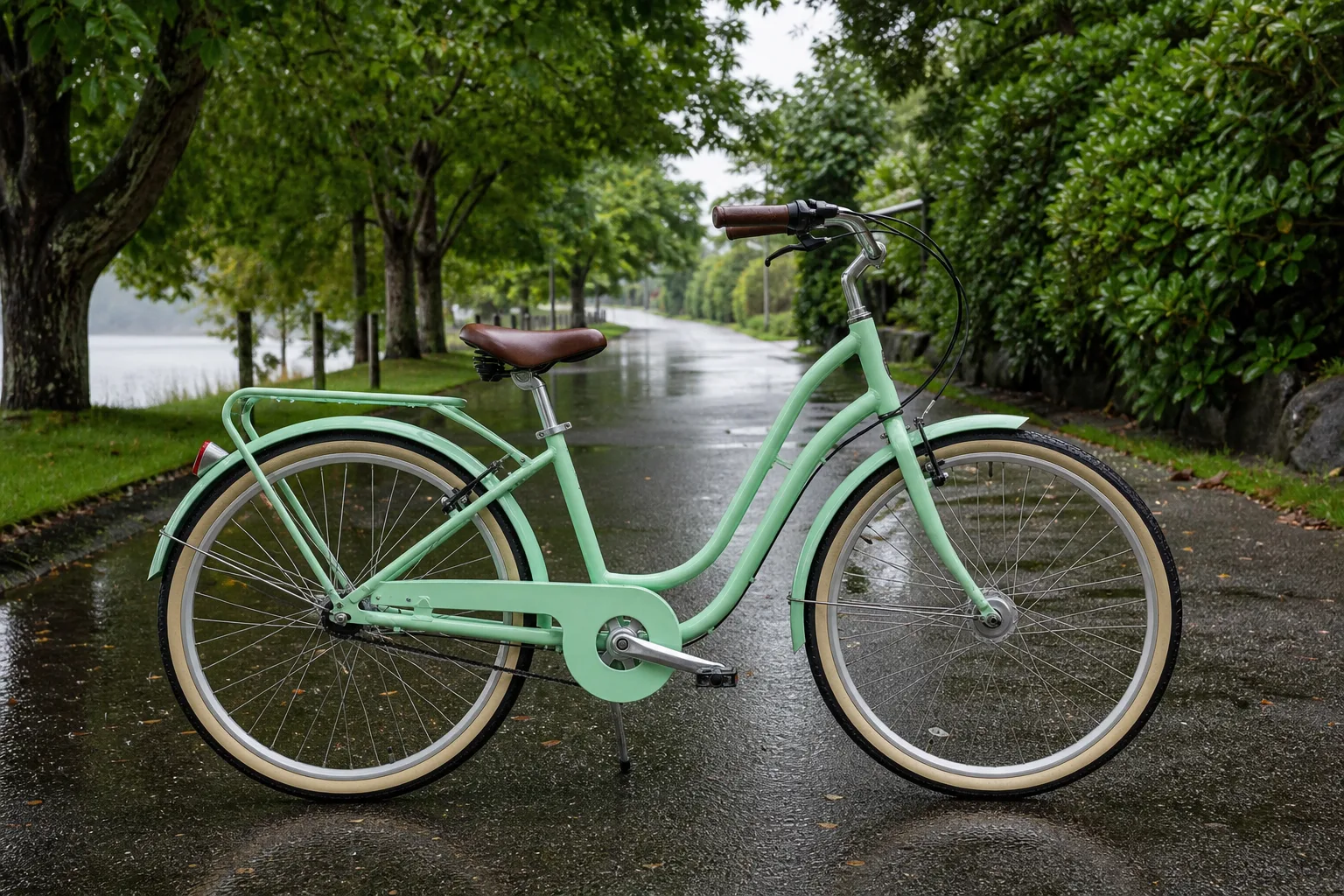
The bike that feels right rolling around a flat parking lot can feel very different four blocks later, on a damp downgrade you did not notice on the way out. Braking and gearing are the two decisions on an upright comfort bike that are hardest to change after purchase, because a coaster brake is built into the rear hub and swapping it means a new wheel, new cable routing, and often a new frame mount. Everything else on a cruiser, the saddle, the grips, the tires, the bars, is cheap to revise later. These two are not.
What a coaster brake actually does when the road is wet
A coaster brake works inside the sealed rear hub, so rain, road grit and puddle spray never touch the friction surfaces. That is its real advantage, and it is a genuine one: the first stop after riding through standing water feels the same as the last dry stop, with none of the half-second delay you get from wet rims. What it cannot do is modulate. Pressure builds quickly, the rear wheel carries maybe a third of your stopping force, and once it locks you are steering a skid rather than braking. On flat pavement at cruiser speeds, that is usually fine.
Hand levers give you the front wheel, which is where the weight transfers under braking and where most of your stopping power lives. Rim brakes on aluminum rims lose bite in the wet for a beat before the pads clear the water, and they wear the rim over years. Mechanical disc brakes shed water faster and hold their feel on a longer descent, at the cost of more setup and periodic pad replacement. Many step-through comfort bikes now ship with a coaster rear and a hand-operated front, which is the arrangement worth seeking out.
What a three-speed or seven-speed hub adds on ground you call flat
Neighborhoods described as flat rarely are. There is a bridge approach, a driveway apron, an underpass climb, a headwind that acts like a two percent grade for half a mile. A single speed handles all of it if your legs are willing to stand up, and plenty of riders are happy that way. A three-speed internally geared hub gives you a low gear for the pull out of a stop with groceries on the rack, a middle gear for cruising, and a high gear for the one stretch where you want to move. Shifting works at a standstill, which matters at every red light.
A seven-speed hub adds finer spacing rather than a dramatically wider range, so the payoff is comfort at a steady cadence rather than new terrain. Compare the low gear specifically, not the number of speeds, and if the shop can tell you the gear inches, ask. On short paved rides with a few gentle grades, three well-chosen ratios usually cover everything a seven-speed does, at lower cost and with less to adjust. Where the seven earns its price is longer errands, hillier suburbs, or a rider recovering knee strength who wants small steps.
The parking lot test that tells you more than the spec sheet
Ask to ride the bike outside, at a real speed, and stop it hard from about ten miles an hour with a marker on the ground. Do it twice with each brake system separately, front only, then rear only, then together, and notice where your hands and feet were when it counted. With a coaster, check whether your pedals happen to sit in a dead spot at the moment you need to backpedal, because the recovery stroke costs distance. The Consumer Product Safety Commission sets the federal requirements bicycles sold in the United States must meet for braking performance, but the number that matters to you is how far you traveled, in your shoes, on that bike.
Repeat the test on a wet surface if you can, even a hosed-down section of lot, and repeat it while pointed slightly downhill. A bike that stops well on level dry asphalt and vaguely on a damp incline has told you something useful for the price of ten minutes. Bring the bag or the child seat you actually plan to carry, since loaded weight lengthens every stop measurably.
Buy the braking arrangement that suits the worst pavement you expect to meet, then choose gears for the grade you meet most often. Those two decisions, settled carefully in the lot, hold up for the life of the bike.